Map of Southwest Arizona incl. Ajo and Organ Pipe Cactus
National Monument
SR-85 brings travelers to Ajo from Gila Bend and Phoenix to the north. SR-86
to the east connects to Tucson, while SR-85 to the south is the route to Organ
Pipe National Monument and to Sonora, Mexico. The Ajo Mountain Scenic Loop
drive is shown in green. View Ajo in a larger
map.
|
Ajo Mountain Scenic Loop Drive can be reached by driving west
from downtown on Rocalla Ave. This will intersect the loop drive that goes
south of town, around the mining operations, south of Ajo Mountain, then
connecting to Bates Well Road. Follow Bates Well Road east back to Hwy 85.
Bates Well Road is also the principal road into Cabeza Prieta National Wildlife
Refuge and the famed "Devil's Highway" (closed to entry for several months in
spring when Desert Pronghorn are calving). Highway 85 north of Ajo passes
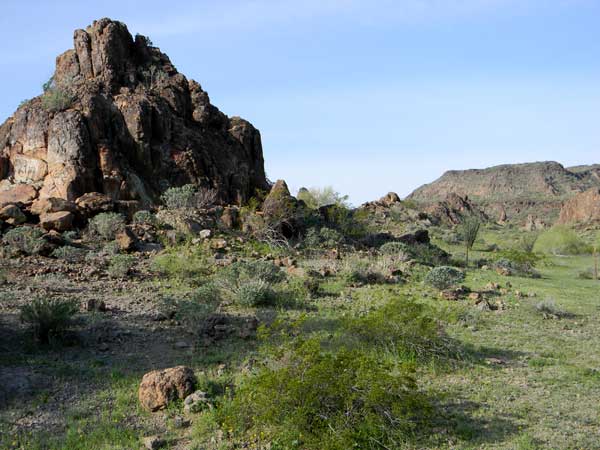
through the Barry Goldwater Bombing Range which is a beautiful desert area as
well. The areas near the highway are a moonscape of volcanic lava fields and
cinder cones. This route will take the traveler to Gila Bend and in the
direction of Phoenix. Head south of Ajo on 85 about 8 miles to Why (great name
for a town at a three-way junction!). There, Hwy. 86 runs east to Tucson and 85
continues south to Organ Pipe National Monument, and Puerto Peņasco (Rocky
Point), Mexico. And of course the great Pinacate/Gran Desierto Reserve lies
just across the Mexican Border. Thus, Ajo provides the desert tourist an ideal
portal to adventure and a comfortable retreat at day's end. Check
Guest House Inn, a Bed & Breakfast or the
Copper Sands Motel in Ajo.
The Cabeza-Prieta Wildlife Refuge occupies part of the Goldwater Range and
requires a permit for entry. Permits are available at the refuge headquarters
at 1611 North Second Avenue in Ajo where there is also a gift shop and helpful
personelle (Phone: (520) 387-6483. Visit the refuge
web page for more information. Frequent travelers to this area should
definately consider membership in the
Cabeza-Prieta Naturali History Association. The association website,
for example, has a photographic guide to many reptiles, plants, geology and
birds of this area. The organization has meetings and field trips in the area.
|